
Expertises: Architecture, Design, Art, Home improvement, Painting
Updated on


Inspiring Ideas for Modern Home
Here is the secret the stone showroom rarely leads with: the finish matters as much as the stone. The same slab of marble can be a glassy, light-catching wall or a soft, matte floor that hides every mark — same quarry, same price class, completely different life in your home. The finish decides how the stone feels under bare feet, how it grips when wet, how it shows wear, and how hard it is to keep clean. Most guides name three finishes and stop. There are at least twelve in regular use, and knowing all of them is the difference between a bathroom you babysit and one you simply live in. This guide covers every finish worth knowing — how each is made, where it belongs, what it hides, and what it demands — with the safety numbers translated into plain language.
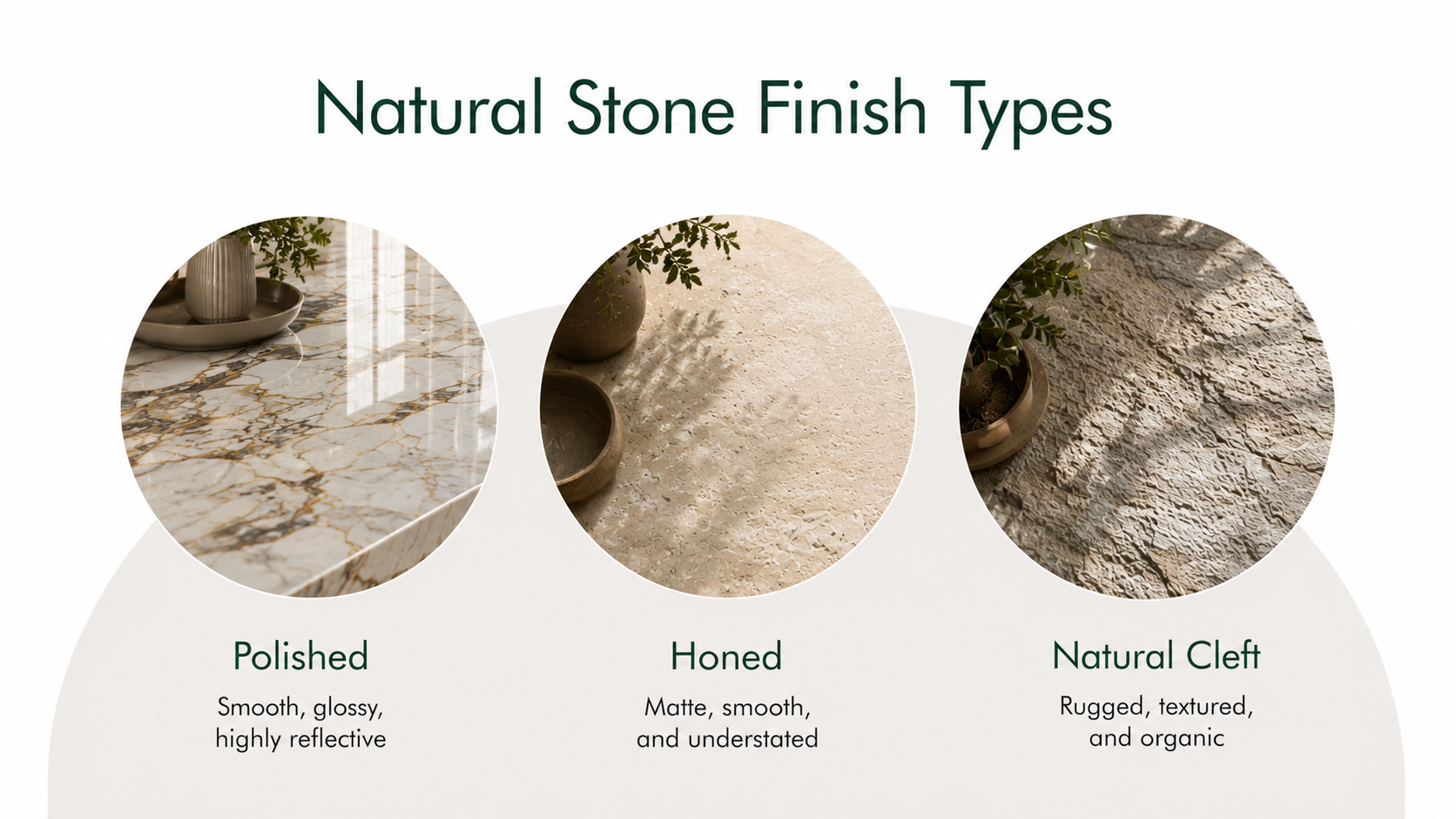
| Finish | Look & Feel | Wet Grip | Best For |
|---|---|---|---|
| Polished | Mirror gloss, color at full depth | Poor | Walls, vanities — never wet floors |
| Honed | Smooth matte or satin | Fair | Bathroom floors, counters, shower walls |
| Leathered | Soft sheen with gentle texture | Fair–Good | Vanities, counters |
| Brushed | Softly worn, slightly undulating | Good | Floors, walls with an aged feel |
| Tumbled | Rounded edges, chalky matte | Good | Shower floors, mosaics, rustic rooms |
| Sandblasted | Uniform fine grit | Very Good | Wet floors, exterior steps |
| Bush-Hammered | Pocked, rugged texture | Excellent | Pool decks, ramps, outdoor wet zones |
| Flamed / Thermal | Rough, crystalline, sun-faded tone | Excellent | Exterior paving, wet rooms |
| Natural Cleft | The stone’s own split face | Very Good | Slate floors, shower floors |
| Acid-Washed / Antiqued | Softened, aged patina | Fair–Good | Walls, floors with vintage character |
| Sawn | Raw, matte, faintly lined | Good | Contemporary walls, floors |
| Filled & Unfilled Travertine | Smooth and cleanable, or pitted and rustic | Varies | Filled indoors; unfilled for rustic texture |
Every finish starts with the same rough slab. Smooth finishes are ground with progressively finer abrasives — stop early and you have honed, keep going and you have polished. Textured finishes go the other way: brushes, sand, flame, or hammers rough the surface up on purpose. That is the whole trade in one sentence. Smoother surfaces are easier to wipe clean but slick when wet and quick to show damage. Rougher surfaces grip like a handshake but hold soap film and ask more of your mop. Neither is better. Each belongs somewhere.
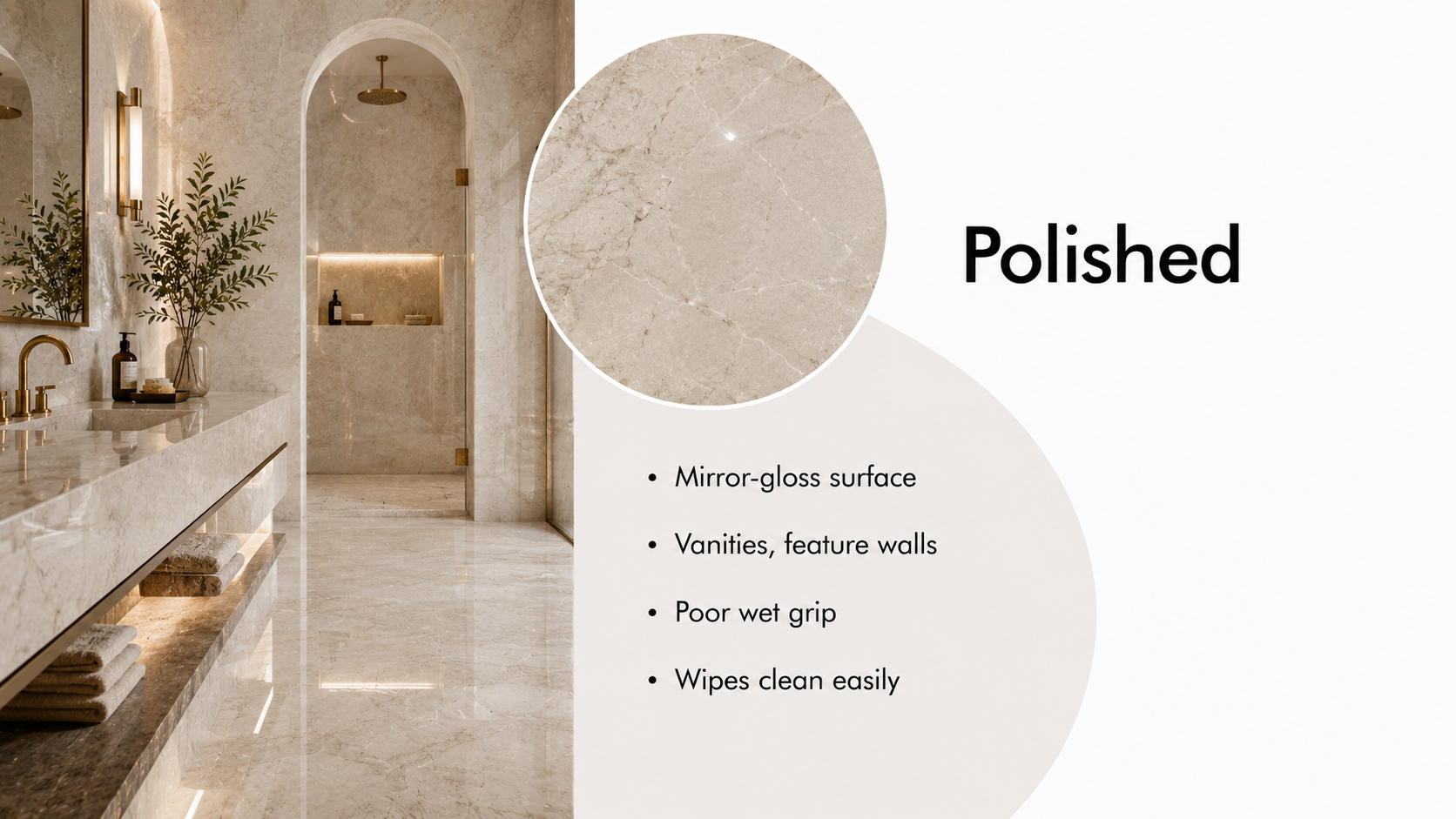
Polished stone is ground and buffed until it reflects like glass. The process closes the surface slightly and pulls the color to full saturation — polished marble looks deeper, darker, and more dramatic than the same stone in any other finish. It is also the easiest surface to wipe down, which is why it owns walls and backsplashes.
What it is not is a wet-floor finish. Polished stone is the worst slip performer in this guide, and on marble and other calcium-based stones it displays every etch mark — the dull spots left when lemon juice, vinegar, or a splashed cosmetic reacts with the surface. No sealer prevents etching; sealers slow stains, not chemistry. Put polish on the walls and the vanity, admire it daily, and keep it off the shower floor.
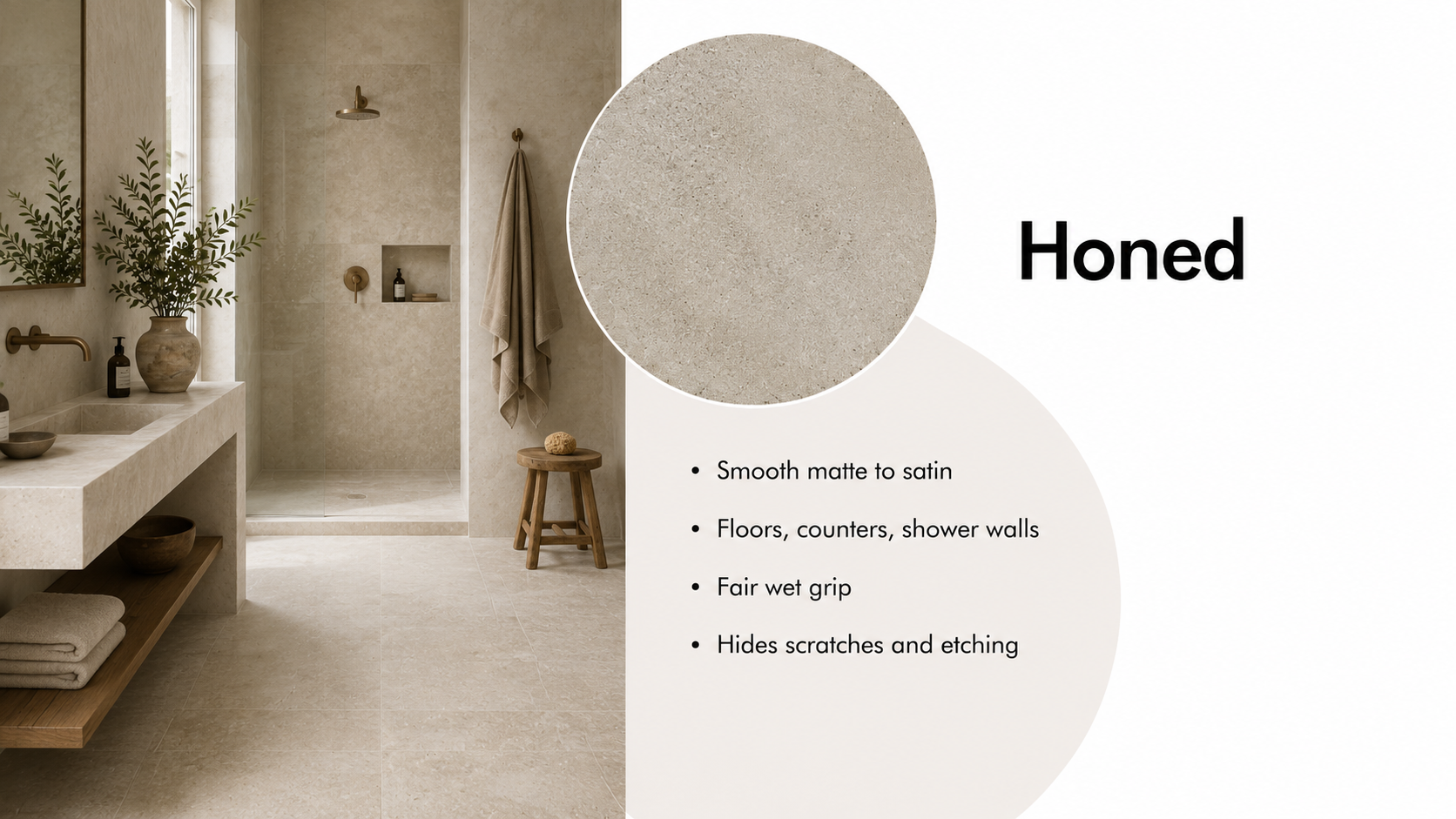
Honed is polished stopped partway: ground smooth, left matte or gently satin, with no mirror shine. It is the workhorse finish of stone bathrooms and the one professionals steer homeowners toward, for one honest reason — a honed surface does not resist etching or scratching any better than a polished one, but it hides both beautifully. A dull mark on an already-matte floor barely registers. One fabricator put it plainly: about ninety percent of the marble he sells is honed.
Underfoot it is comfortable and reasonably grippy when dry, fair when wet — fine for the main bathroom floor, best backed up by a mat at the tub. Honed stone absorbs slightly faster than polished, so keep it sealed and clean it with pH-neutral stone cleaner, never vinegar.
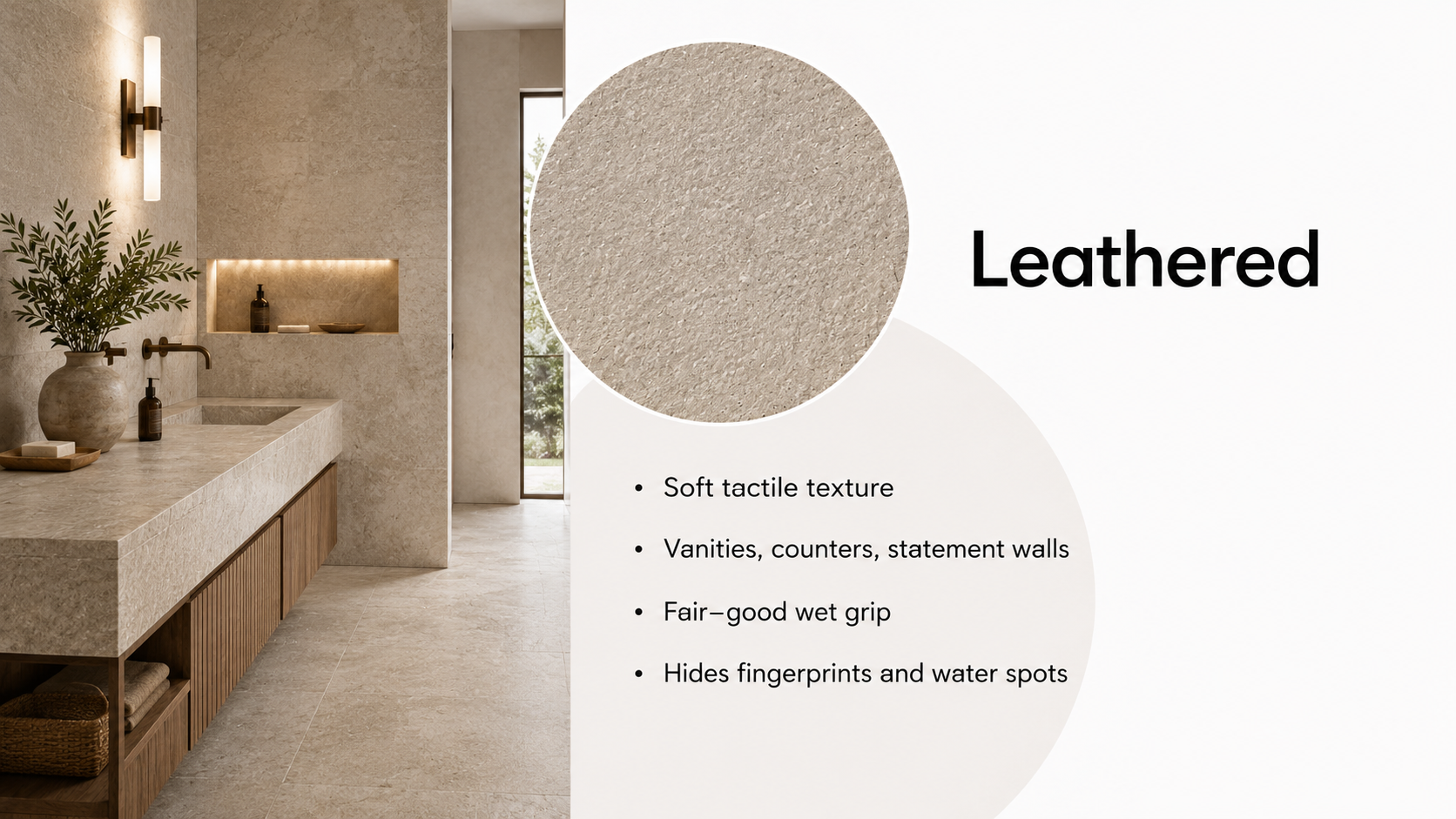
Leathered stone is brushed with diamond-tipped pads until it carries a soft, tactile texture — closer to its namesake than to satin — with a low sheen that sits between honed and polished. It has become the favorite finish for granite, quartzite, and soapstone counters because it hides the two things polished tops broadcast: fingerprints and water spots.
In the bathroom it is a vanity-top finish first, a wall finish second. The texture adds a little wet grip over honed, and it disguises hard-water film better than any smooth finish. It does open the surface slightly, so a granite sealer or the equivalent for your stone stays on the maintenance calendar.
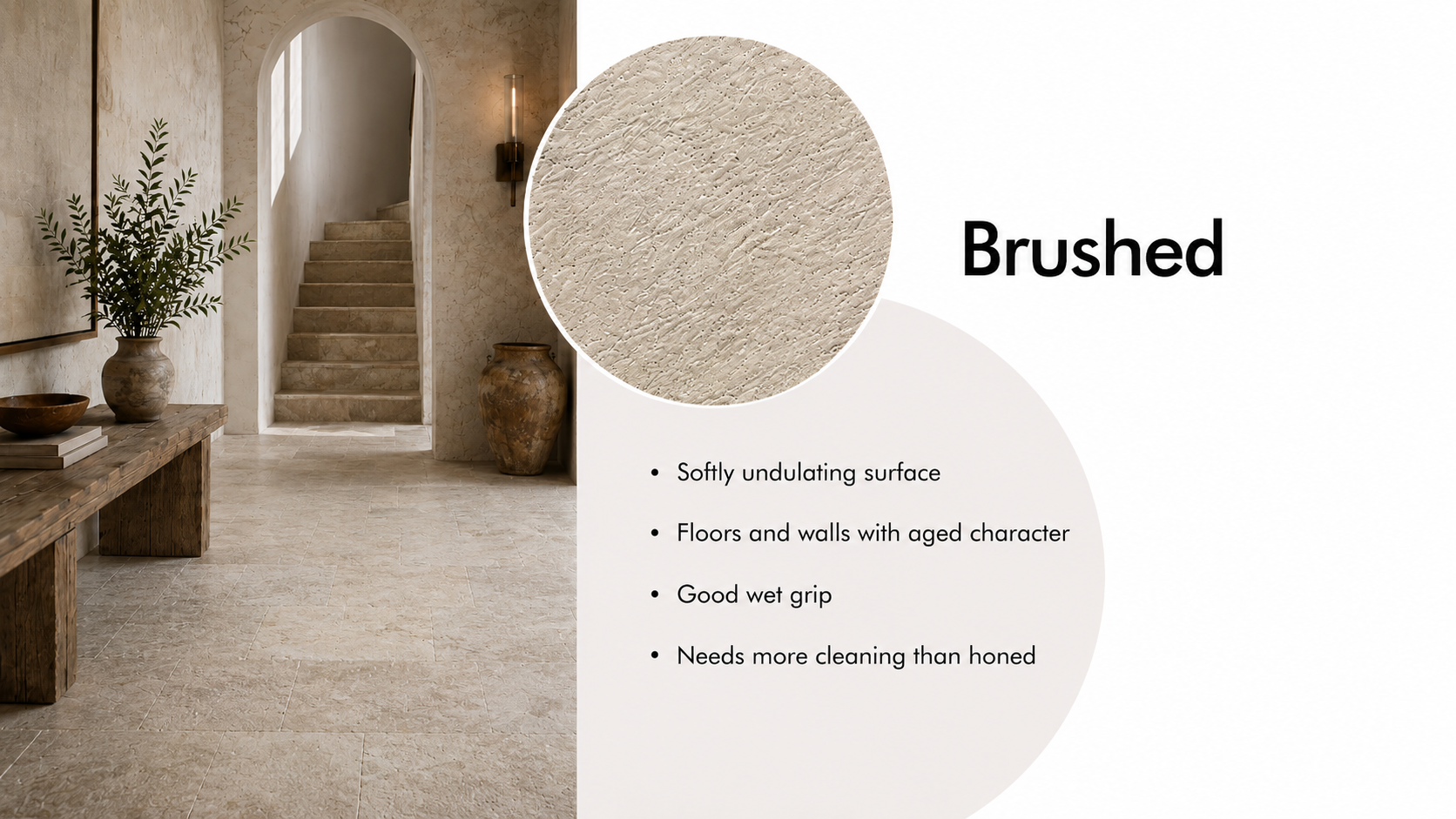
Brushed finishes use stiff wire or abrasive brushes to wear away the stone's softest particles, leaving a gently undulating surface that looks and feels softly aged — as if the floor had a few decades of graceful use behind it on installation day. It is subtler than tumbled, smoother than sandblasted, and flattering to limestone, travertine, and marble.
Brushed floors offer good wet grip and forgive the small scratches and scuffs of family life. The undulation holds a little more soap residue than honed, so showers finished in brushed stone reward a weekly rinse-down. It is one of the best all-around compromises in this guide: texture enough for safety, smoothness enough for cleaning.
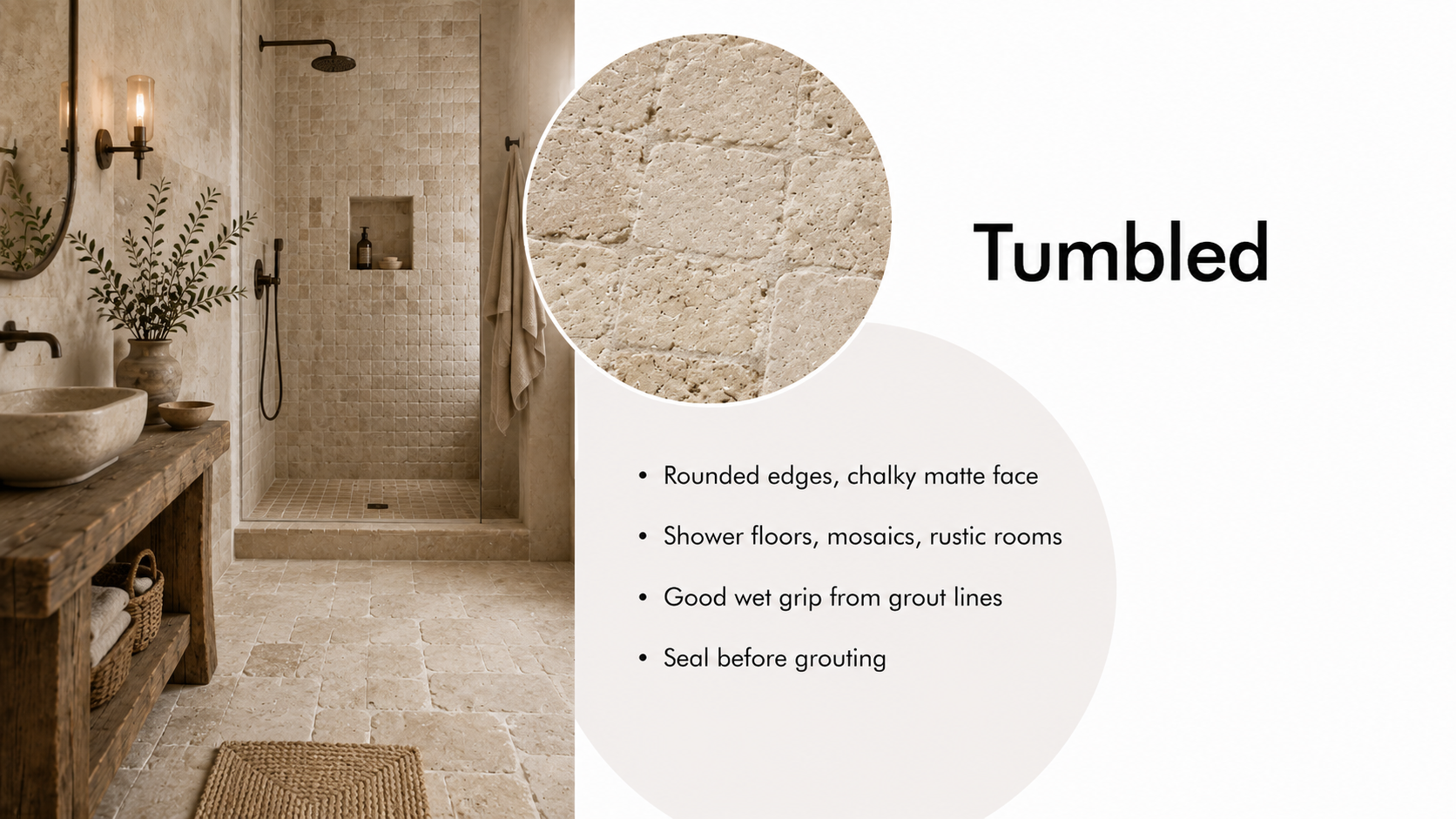
Tumbled stone is finished the way the sea finishes pebbles — tiles are literally tumbled in drums with abrasive grit until edges round off and surfaces go chalky and matte. The result reads instantly as rustic, aged, Mediterranean. Tumbled travertine and marble mosaics have been shower-floor staples for decades, and for a practical reason beyond looks: all those rounded small tiles mean many grout lines, and grout lines are traction.
Tumbling opens the stone's pores, so sealing before grouting and on a regular cycle afterward is not optional. The chalky surface also drinks stains faster than honed. In exchange you get the friendliest barefoot feel in the smooth-finish family and a floor that treats slips as someone else's problem.
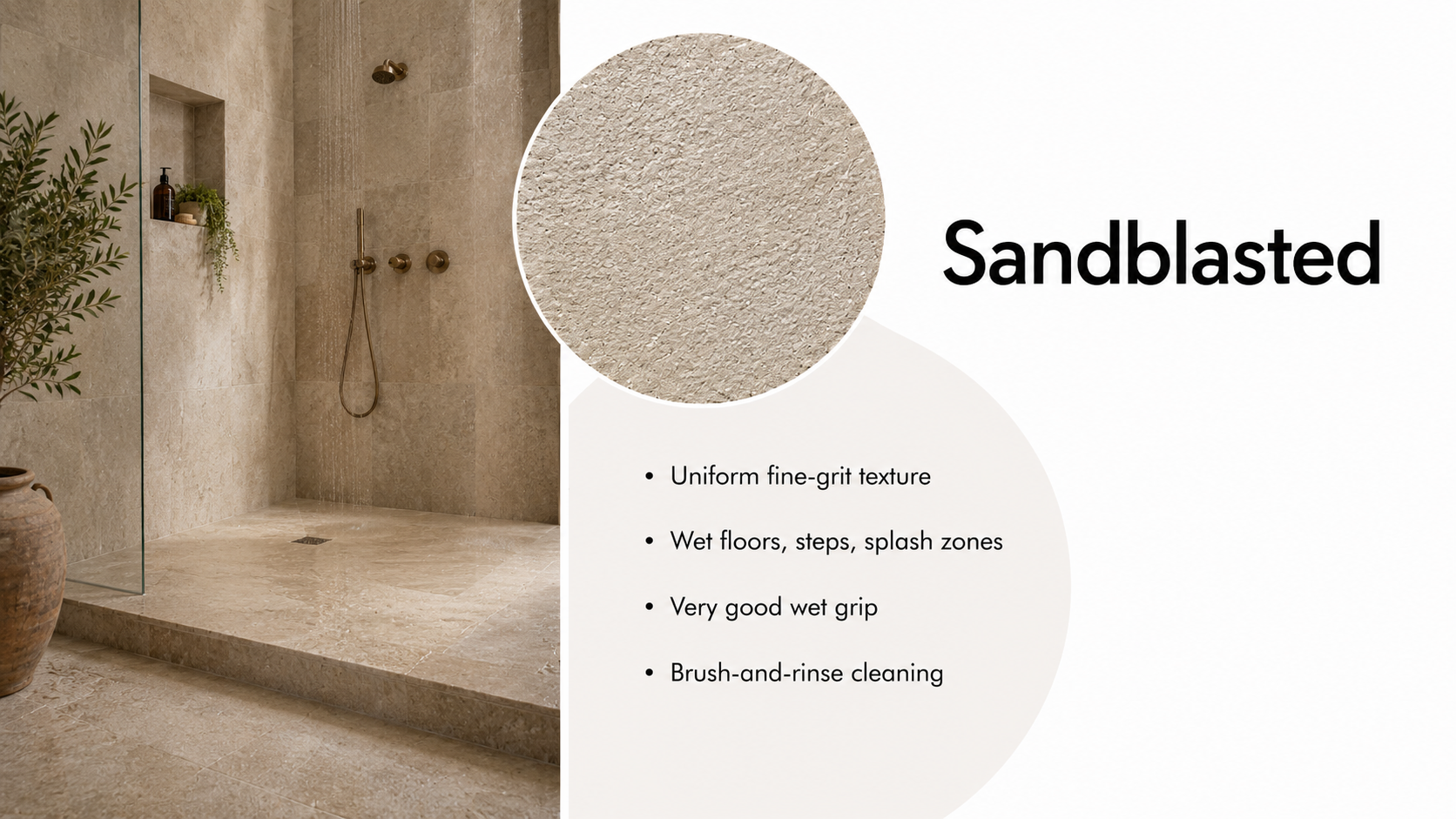
Sandblasting fires abrasive at the stone until the surface carries a uniform, fine-grained grit — think very fine sandpaper rendered in stone. It lightens the stone's color noticeably and delivers very good wet traction, which makes it a strong choice for wet-room floors, exterior steps, and anywhere bare feet meet standing water.
The trade-off is the honest one that runs through every textured finish: grit holds grime. Sandblasted floors want a proper brush-and-rinse rather than a quick wipe, and pale sandblasted stone will show shadowing in traffic lanes if neglected. Where safety leads the brief, it earns the extra scrubbing.
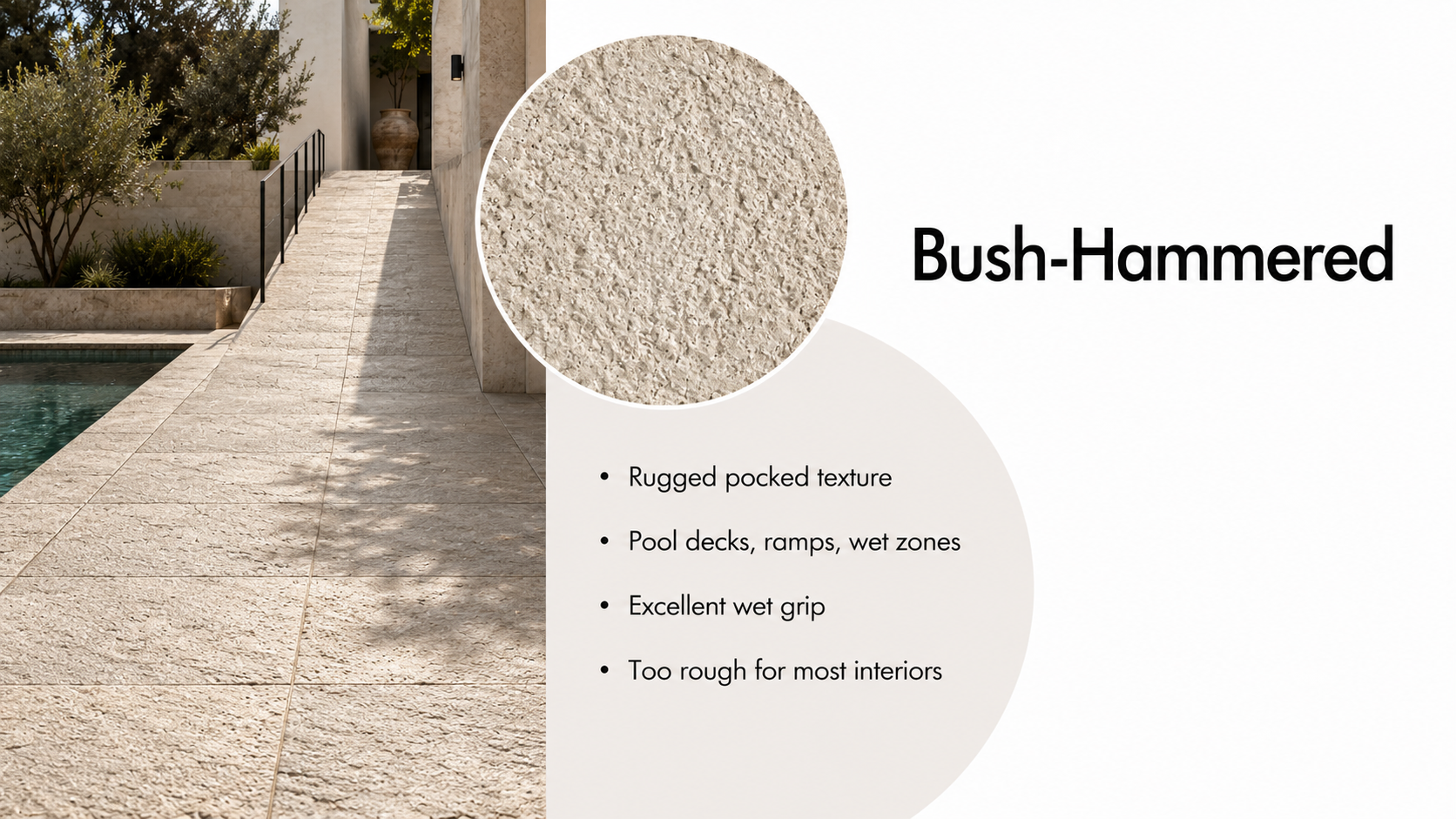
Bush-hammering is the oldest texture in the book: a hammer faced with tiny points pounds the surface into a field of small craters. The result is rugged, unmistakably hand-worked, and about as slip-resistant as natural stone gets. This is the finish of pool decks, outdoor stairs, ramps, and the wettest zones of spa bathrooms — the places where falling is the one outcome the floor must prevent.
It suits dense stones — granite, basalt, hard limestone — and reads too rough for most interior rooms outside a deliberately rustic scheme. Cleaning is a brush job. Choose it where grip is the entire assignment and it will never disappoint.
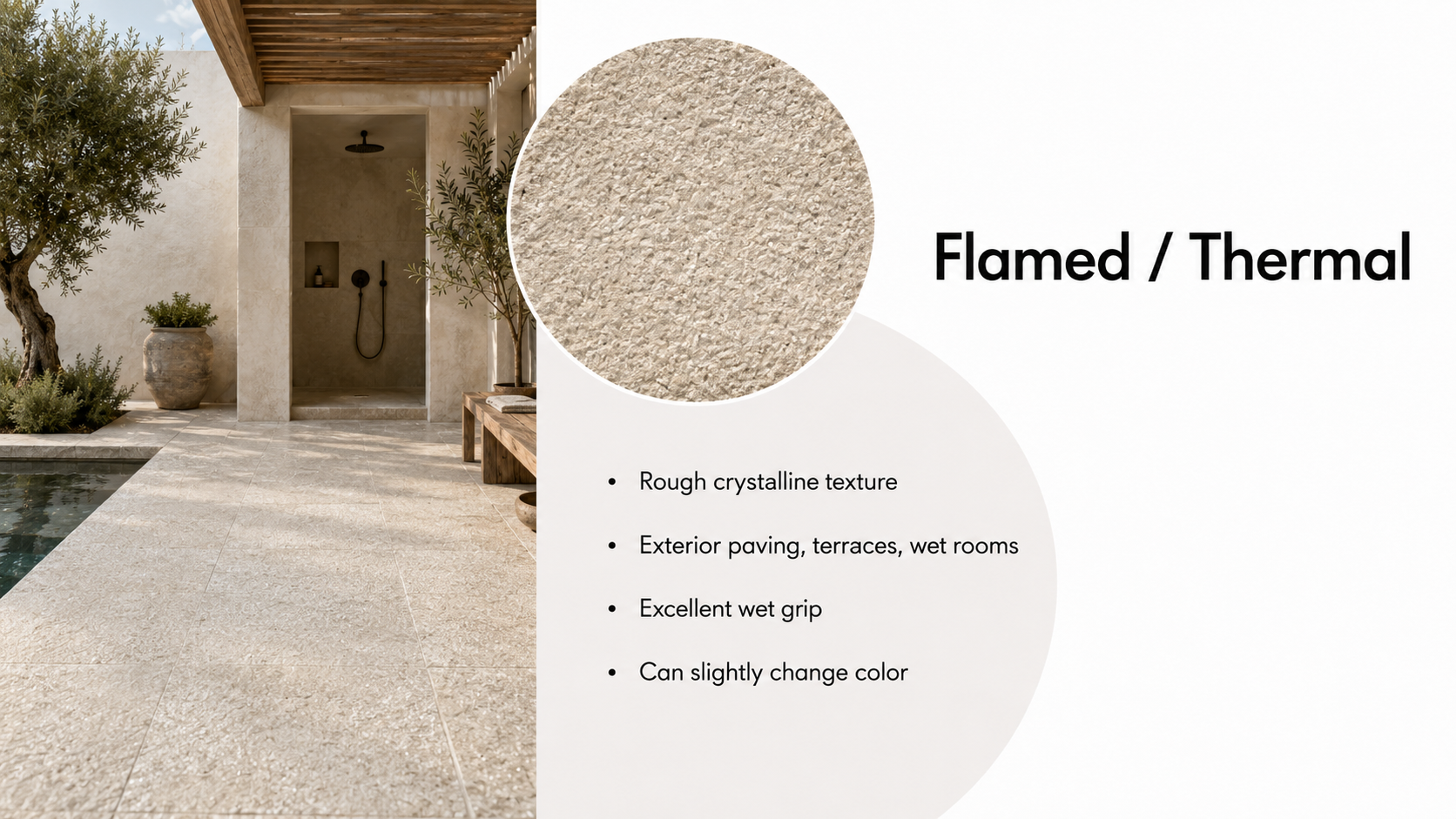
Flamed — or thermal — finishing passes a torch across the stone at extreme heat until the surface crystals pop and spall, leaving a rough, faded, slightly glittering texture. It only works on stones with high quartz content, which in practice means granite and quartzite, and it is the default finish of exterior granite paving worldwide for the same reason bush-hammering rules pool decks: excellent traction, wet or dry.
Flaming mutes the stone's color toward softer, greyer tones — a flamed sample never matches its polished sibling, so approve the actual finish, not the showroom slab. Indoors it belongs to wet rooms and bold, textural design; outdoors it is simply the standard.
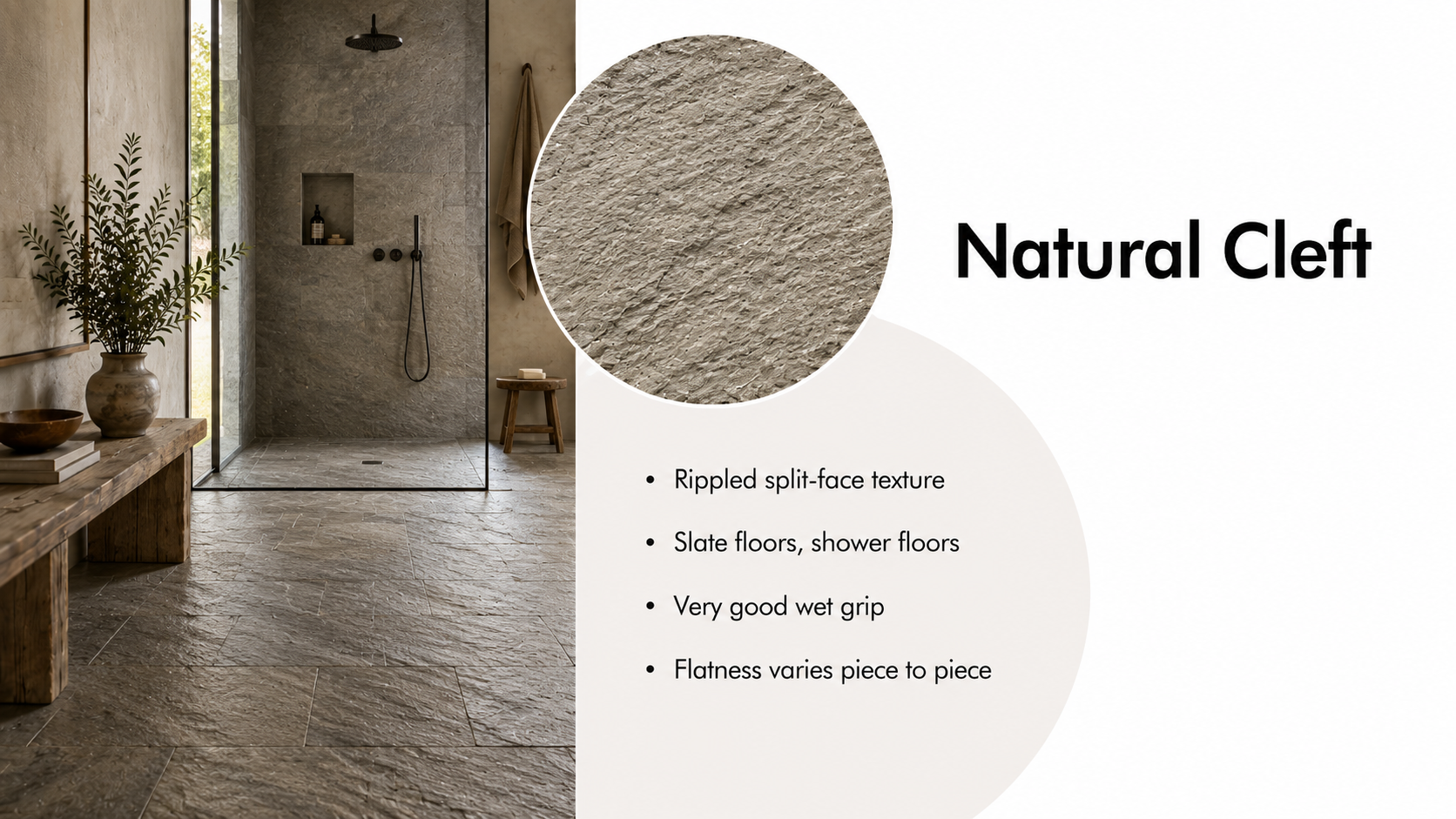
Natural cleft is not applied at all — it is the face the stone gives itself when split along its own layers. Slate is the classic: it cleaves into sheets with a rippled, matte, naturally grippy surface that no factory process quite imitates. Some sandstones and quartzites split the same way.
That authenticity is the appeal and the caveat in one. Cleft surfaces vary in thickness and flatness from piece to piece, so floors need an experienced installer (or "gauged" stock, machine-ground flat on the back). Underfoot the grip is very good and the character unmatched — a cleft slate shower floor is one of the safest natural surfaces you can stand on with soap in your eyes.
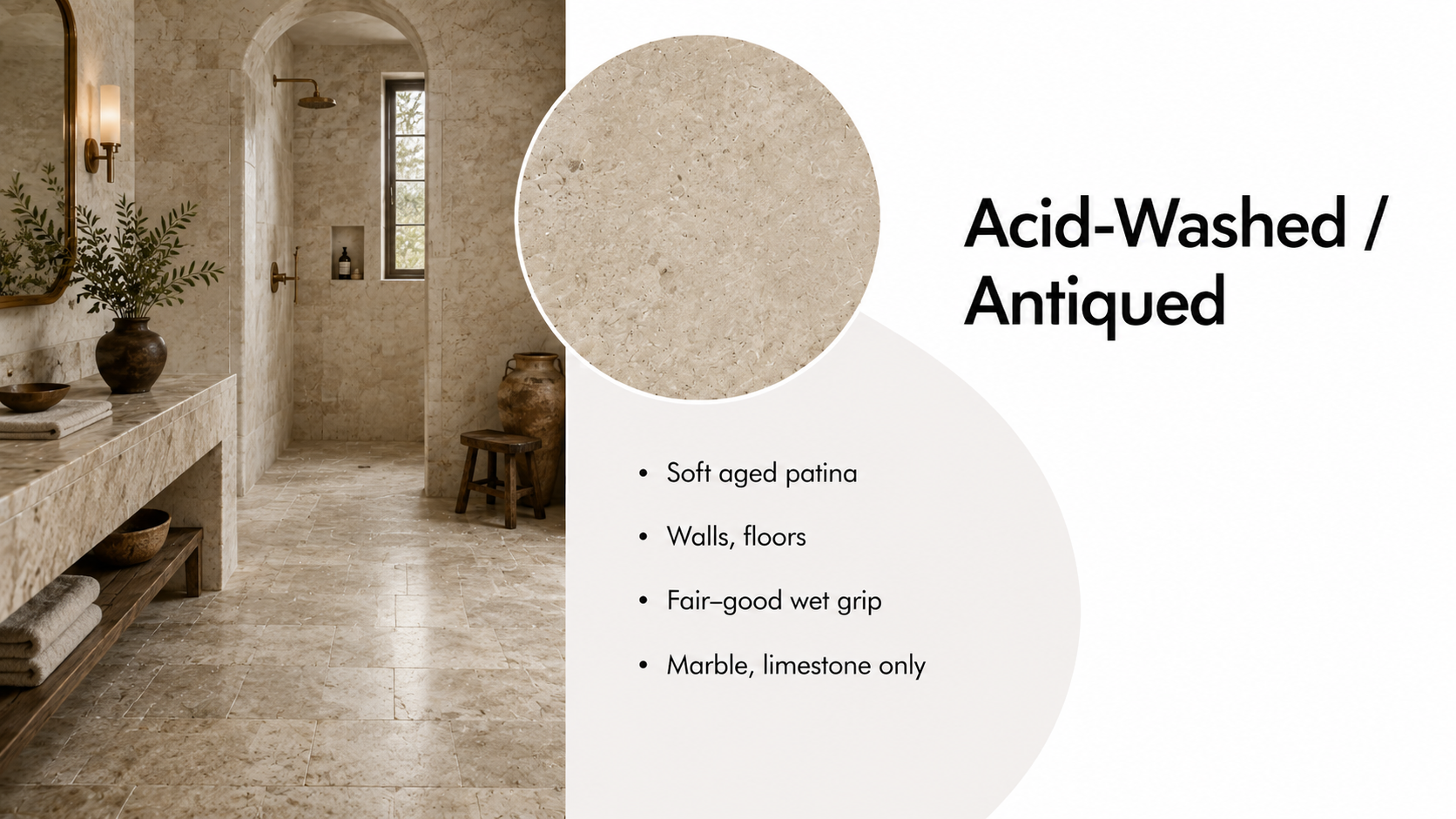
Acid-washing bathes the stone in a mild acid solution that softly dissolves the surface, dulling shine and aging the face in minutes rather than decades. On marble and limestone it is, quite literally, controlled etching — which is why it partners naturally with those stones: a floor that has already been uniformly etched has nothing left to fear from a splash of lemon.
The finish reads as gentle patina — old-world, lived-in, forgiving of wear because wear is the aesthetic. Grip improves modestly over polished. It is a walls-and-floors finish for rooms chasing vintage character, and one of the smartest choices for households that love marble but refuse to police it.
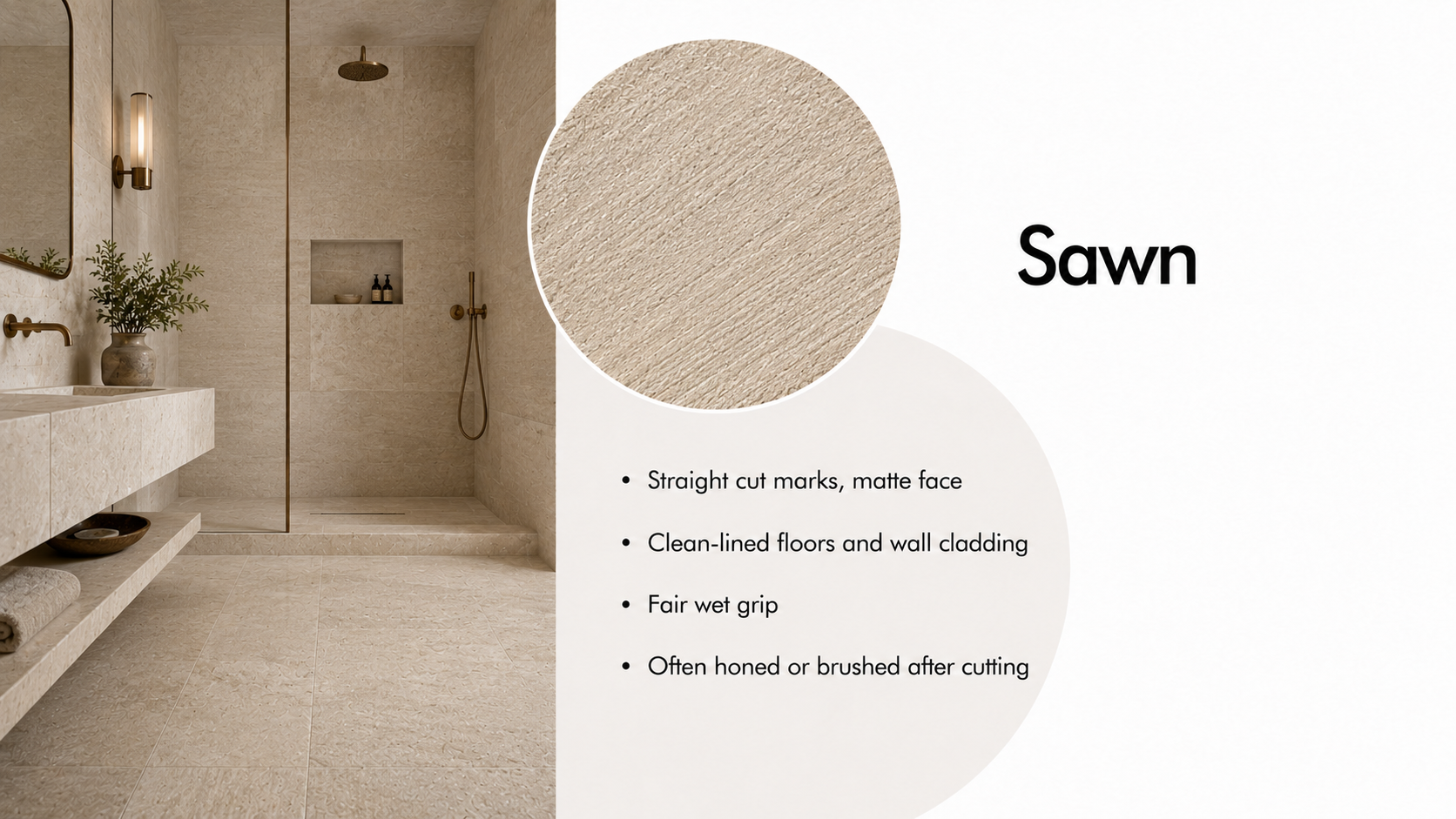
Sawn is the rawest finish sold: the surface exactly as the gang saw left it, matte, faintly lined with blade marks, entirely unpretentious. For most of history it was an intermediate stage on the way to honing. Contemporary design rediscovered it for precisely that honesty — sawn limestone and sandstone walls carry a monastic, architectural calm that polish cannot fake.
Grip is good, maintenance is straightforward, and cost is often lower, since the fabricator skipped several steps. Verify the surface has been eased enough for comfort where hands and feet touch it; some sawn faces arrive genuinely rough. A quiet, confident finish for modern rooms.
Travertine gets a finish choice all its own. The stone forms around escaping gas bubbles, which leave its signature pits and voids — and the first question of any travertine order is what to do with them. Filled travertine has the voids packed with color-matched resin or cement at the factory, then honed smooth: the standard choice for interiors, easy to clean, calm underfoot. Unfilled travertine keeps every pit open: gloriously rustic, texturally rich, and a dedicated collector of soap, grime, and grout haze in a bathroom.
The honest guidance: filled-and-honed for bathroom floors and walls, unfilled for feature walls and exterior work where the texture is the point and the hose does the cleaning. Site-filling during installation is possible but rarely as tidy as factory fill. Either way, travertine is a calcium stone — seal it, and keep the vinegar away.
One elegant move ties this whole guide together: run a single stone through several finishes. The same material honed in the bathroom, brushed at the terrace door, and bush-hammered at the pool reads as one seamless design while each zone gets the traction it needs. Frost-proof dense limestones are the classic vehicle — and the storied example is Italian stone for flooring and wall covering in Biancone, the typical Trani limestone, quarried since the Middle Ages, facing its hometown cathedral for nearly nine hundred years, and finished today in everything from polish to bush-hammer, which is exactly why one stone can carry a whole house, indoors and out, in styles from modern to rustic to shabby chic.
Tumbled, natural cleft, sandblasted, and flamed finishes lead, with tumbled mosaics the residential favorite because their many grout lines add traction on top of the surface texture. Aim for a wet DCOF of 0.50 or higher (the US barefoot-wet-area tier) or European class B–C. Polished stone should never be a shower floor, whatever the stone.
Polished, by a distance — its sealed-tight gloss wipes clean in one pass — followed by honed. Cleaning effort rises exactly as texture does: leathered and brushed take a little more, tumbled and sandblasted more still, and bush-hammered wants a brush. That is the standing trade of this entire guide: grip and cleanability pull in opposite directions, and the room decides the winner.
All natural stone benefits from a penetrating sealer, but texture raises the stakes: tumbling, brushing, and blasting open the stone's pores, so those finishes absorb faster and reseal sooner. The test is simple — leave a drop of water on the surface for fifteen minutes, and if the stone darkens, it is time. One thing no sealer does on marble, limestone, or travertine is stop acid etching; that is chemistry, and the defenses are matte finishes that hide it, or habits that avoid it.
Often, yes — and it is one of natural stone's best-kept secrets. Restoration professionals can hone a polished floor in place (the standard fix for an etched, worn marble floor), re-polish a honed one, and refresh most smooth finishes on-site with diamond abrasives. Heavy textures are harder to add after the fact — flaming and bush-hammering are fabrication processes — but the smooth family is genuinely renewable, which is why century-old stone floors keep getting new lives.
Both are matte, but honed is flat-smooth while leathered carries a soft, tactile texture with a whisper of sheen. Honed is the classic floor finish; leathered is the rising counter finish, prized for hiding fingerprints and water spots on granite, quartzite, and soapstone. Underfoot they behave similarly; under hands and daily wipe-downs, leathered forgives more.
